Showing posts with label accounting basics. Show all posts
Accounting Basics: Current Assets - Accounts Receivable
Accounting Basics: Current Assets

We've previously discussed what Assets are. In an unclassified balance sheet where you only have 3 major classifiations (assets, liabilities and owners equity) that would be in the story. A much more useful report is the Classified Balance Sheet. Here, the three major categories are subdivided to provide readers of the financial statements with much more detailed information. The first such subdivision under assets is Current Assets.
Current Assets are defined as those assets which will either be converted into cash or otherwise 'used up' by the business in a relatively short period of time (generally one year or less). On the balance sheet, they are generally presented in order of liquidity; thus cash is generally listed first.
Other examples of current assets include accounts receivable, notes receivable (which often have a current and a non-current portion) and prepaid expenses. These will be examined in future entries.
Accounting Basics: Assets
As hinted in my previous entry, the balance sheet is comprised of three basic sections: assets, liabilities and owners equity. Assets are resources or items of value owned by the business. They are items of value which can be used or exchanged in the production or delivery of services of the business.
Typically, the most common asset people think of is cash. Cash can be exchanged to purchase office supplies, raw materials used in production, pay employees, etc.; thus it is an asset of the business. Machinery is another asset; it is used in the production of the goods or services delivered by the business.
Substantial effort is made by accountants in valuing assets; some of which may not have a clear current value. For example, a piece of equipment purchased five years ago for $100,000 and used daily in the operation of the business is not worth $100,000 today (in the same way that a five year old car is not worth the price paid for it when it was new). In this instance, accountants use depreciation to adjust the value of a 'fixed asset' such as this (to be discussed later).
Typically, the most common asset people think of is cash. Cash can be exchanged to purchase office supplies, raw materials used in production, pay employees, etc.; thus it is an asset of the business. Machinery is another asset; it is used in the production of the goods or services delivered by the business.
Accounting Basics: The Balance Sheet
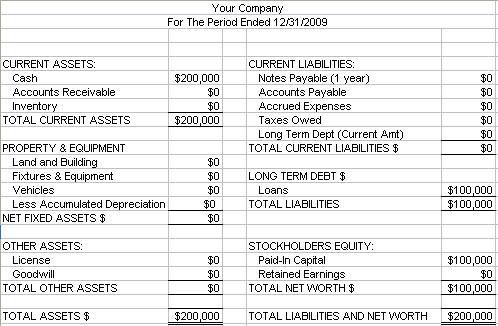
If you view the balance sheet as a two column worksheet, the assets would be in the left column while the liabilities and owners equity would be in the right column. The two columns must be equal.
Future entries in my Accounting Basics series will describe each of the components of the balance sheet.
Accounting Basics: Management Accounting vs. Financial Accounting
The private accounting field can be further divided into two sub-categories depending on how the information generated by the accountant is used.
As its name implies, Management (or Managerial) Accounting provides that information which is used by managers within the company. The information provided can be as broad as long range financial projections or as detailed as analyzing cost variances (ie budget overages). Wikipedia defines management accounting as being " concerned with the provisions and use of accounting information to managers within organizations, to provide them with the basis in making informed business decisions that would allow them to be better equipped in their management and control functions."
Accounting Basics: Public Accounting vs. Private Accounting
Next in my Accounting Basics Series: Public Accounting vs Private (Industrial) Accounting.
The old accounting text book defines public accounting as: offering accounting and related services for a fee to companies, other organizations and the general public. The other services can include auditing, tax services and consulting. The certification offered for this type of accountancy is a Certified Public Accountant. The exam is prepared and administered by the American Institute of Certified Public Accountants (AICPA).
Private (or industrial accounting) is the opposite. Instead of providing services to many clients, a private accountant provides services to a single business. In a business consisting of many accountants, the 'head accountant is typically called the controller. Private accountants may or may not be CPA's. The National Association of Accountants does offer a certificate for private accountants called a Certificate in Management Accounting (CMA). Private accountants are often much more specialized and have to adapt to the needs of their company (controlling costs, budgeting, accounting systems, etc.)
The old accounting text book defines public accounting as: offering accounting and related services for a fee to companies, other organizations and the general public. The other services can include auditing, tax services and consulting. The certification offered for this type of accountancy is a Certified Public Accountant. The exam is prepared and administered by the American Institute of Certified Public Accountants (AICPA).
Private (or industrial accounting) is the opposite. Instead of providing services to many clients, a private accountant provides services to a single business. In a business consisting of many accountants, the 'head accountant is typically called the controller. Private accountants may or may not be CPA's. The National Association of Accountants does offer a certificate for private accountants called a Certificate in Management Accounting (CMA). Private accountants are often much more specialized and have to adapt to the needs of their company (controlling costs, budgeting, accounting systems, etc.)
Accounting Basics: Accounting and The Accounting Cycle
What is accounting? My old accounting text book defines it as: "the process of identifying, measuring, and communicating economic information to permit informed judgments and decisions by the users of the information." The text distinguishes between accounting and bookkeeping. Whereas bookkeeping involves the mechanical process of recording economic activities, accounting expands on that to include analysis and interpretation of financial information as well as preparing financial statements, conducting audits, designing accounting systems, etc.
Since this is a web based forum, lets look at Wikipedia's definition: the measurement, disclosure or provision of assurance about financial information primarily used by managers, investors, tax authorities and other decision makers to make resource allocation decisions within companies, organizations, and public agencies. The terms derive from the use of financial accounts. Accounting is the art of measuring, communicating and interpreting financial activity. Accounting is also widely referred to as the "language of business".
Any way you look at it, accounting is a process. It is a process of identifying economic events related to a business activity, recording these events, and subsequently reporting on this business activity with some means of financial representation (financial statements or other reports).
Accounting can be represented as a cycle:
Since this is a web based forum, lets look at Wikipedia's definition: the measurement, disclosure or provision of assurance about financial information primarily used by managers, investors, tax authorities and other decision makers to make resource allocation decisions within companies, organizations, and public agencies. The terms derive from the use of financial accounts. Accounting is the art of measuring, communicating and interpreting financial activity. Accounting is also widely referred to as the "language of business".
Any way you look at it, accounting is a process. It is a process of identifying economic events related to a business activity, recording these events, and subsequently reporting on this business activity with some means of financial representation (financial statements or other reports).
Accounting can be represented as a cycle:
- Observe events.
- Identify those events which are economic events.
- Measure the economic events.
- Record measurements.
- Classify measurements.
- Summarize measurements.
- Report business activity in financial statements or other reports.
- Interpret the contents of financial statements and other reports.
Subscribe to:
Posts (Atom)