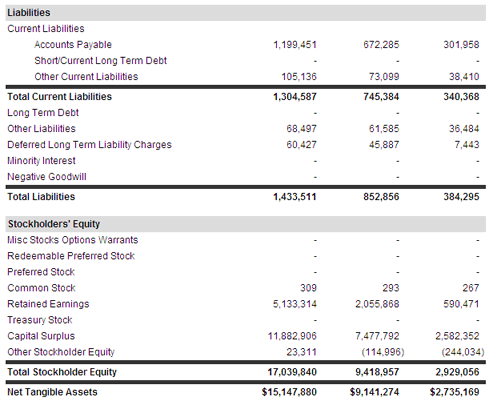
As hinted in my previous entry, the balance sheet is comprised of three basic sections: assets, liabilities and owners equity. Assets are resources or items of value owned by the business. They are items of value which can be used or exchanged in the production or delivery of services of the business.
Typically, the most common asset people think of is cash. Cash can be exchanged to purchase office supplies, raw materials used in production, pay employees, etc.; thus it is an asset of the business. Machinery is another asset; it is used in the production of the goods or services delivered by the business.
 Substantial effort is made by accountants in valuing assets; some of which may not have a clear current value. For example, a piece of equipment purchased five years ago for $100,000 and used daily in the operation of the business is not worth $100,000 today (in the same way that a five year old car is not worth the price paid for it when it was new). In this instance, accountants use depreciation to adjust the value of a 'fixed asset' such as this (to be discussed later).
Typically, the most common asset people think of is cash. Cash can be exchanged to purchase office supplies, raw materials used in production, pay employees, etc.; thus it is an asset of the business. Machinery is another asset; it is used in the production of the goods or services delivered by the business.
 Substantial effort is made by accountants in valuing assets; some of which may not have a clear current value. For example, a piece of equipment purchased five years ago for $100,000 and used daily in the operation of the business is not worth $100,000 today (in the same way that a five year old car is not worth the price paid for it when it was new). In this instance, accountants use depreciation to adjust the value of a 'fixed asset' such as this (to be discussed later).